
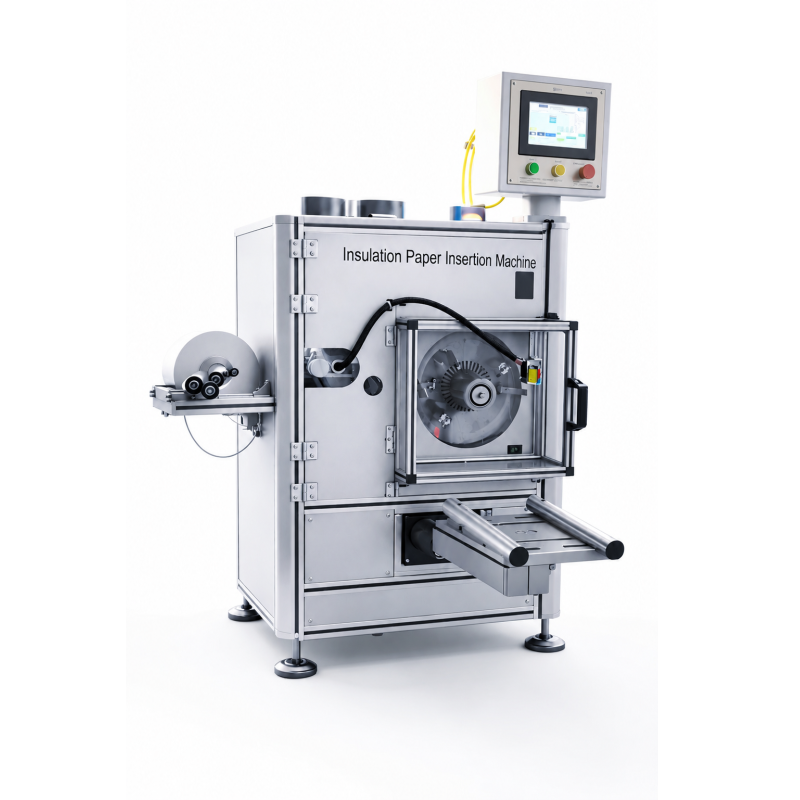
This stator insulation inserter is automatic equipment for placing slot insulation paper into the stators of medium and large motors. It brings paper feeding, edge folding, punching, and forming into one operating sequence. For a production team, that means the slot-paper operation can be handled by a single machine process rather than a series of separate manual steps. The equipment is designed around stator work, with settings adjusted from the operation control panel when the slot quantity changes.
As a slot paper insertion machine, it is intended for applications that need formed insulation paper placed in stator slots with a repeatable sequence. The source material also states that the machine can perform automatic interval-slot and skip-slot insertion. This is particularly relevant when a motor design uses a defined insertion pattern rather than the same paper action in every slot. The machine is not described as a complete production line; its role is the insulation-paper insertion stage within the stator process.
The stator insulation inserter combines four stated operations: paper feeding, edge folding, punching, and forming. Combining these tasks gives the paper a prepared form before insertion into the stator. The available description identifies the equipment as dedicated automatic machinery for this process, making it suitable for manufacturers working with medium and large stators.
For motor manufacturing automation, the value of this arrangement is a clearly defined paper-insertion operation. The sequence begins with feeding the insulation paper and continues through folding, punching, and forming. The stated cycle time is approximately 1.2 seconds per slot, subject to the machine's specified operating conditions. This capability is useful when a production route calls for consistent slot-paper preparation and insertion across a run of compatible stators.
Changeover is also part of the machine's stated function. When the number of stator slots changes, the operator can modify parameter settings on the operation control panel. The product information further states that mold replacement for different stator slot types is convenient and fast. In practical terms, a slot paper insertion machine should be matched to the stator dimensions, slot form, paper material, and planned production sequence before use.
A stator insulation inserter is most useful when its listed size and material limits correspond to the actual stator being processed. The machine supports a stator core length of 40–200 mm, an outer diameter up to 210 mm, and an inner diameter of 70–150 mm. These published dimensions provide a practical starting point for determining whether a given stator falls within the stated range.
| Item | Published specification |
|---|---|
| Stator core length | 40–200 mm |
| Stator outer diameter | Up to 210 mm |
| Stator inner diameter | 70–150 mm |
| Edge-fold height | 2–4 / 4–7 mm |
| Slot paper thickness | 0.188–0.35 mm |
| Cycle time | Approximately 1.2 sec/slot |
| Power supply | 380 V, 50/60 Hz, 3.5 kW |
| Machine weight | Approximately 500 kg |
| Dimensions | 1100 × 900 × 1500 mm |
Paper thickness, edge-fold height, and stator dimensions are connected operating considerations. A stator insulation inserter should therefore be discussed against the actual paper and stator requirements rather than by a single dimension alone. The listed 0.188–0.35 mm paper-thickness range and two stated edge-fold-height ranges help define the material conditions covered by this configuration.
The supplied product information lists new energy vehicle, industrial, home-appliance, pump, and fan applications. In these sectors, motor manufacturing automation may involve a sequence of stator operations in which insulation-paper insertion is one defined stage. This equipment is positioned for that stage: it forms and inserts slot paper into suitable stators rather than claiming to cover every upstream or downstream operation.
For a new energy vehicle motor program, the equipment can be considered where the stator dimensions and paper conditions align with the published range. Discussions of EV motor production efficiency should focus on the actual stator design, target process sequence, tooling, and production conditions. The stated automatic paper-handling sequence and approximately 1.2-second-per-slot cycle time are useful product facts for that conversation.
Pump motors, fans, industrial motors, and home-appliance motors may likewise use a slot paper insertion machine when their stator requirements match the available limits. Interval-slot or skip-slot capability can matter where the process calls for these patterns. The machine's compact published footprint of 1100 × 900 × 1500 mm and approximate 500 kg weight also provide concrete planning information for a suitable installation area.
Motor variants can differ in slot geometry, core length, paper thickness, and insertion pattern. A stator insulation inserter with adjustable slot-quantity parameters and stated tooling-change support gives a clear basis for discussing those variables. More functions do not automatically mean a closer fit; the relevant question is whether the machine's published range and process capabilities correspond to the stator operation required.
For insulation-paper insertion work, the relevant machine information is its stated automatic process, supported stator range, paper-thickness range, and insertion-pattern capability. A configuration discussion can cover the required stator drawing, slot quantity, core dimensions, insulation-paper thickness, fold height, and desired insertion pattern. These details help clarify how a slot paper insertion machine would fit the intended operation.
For teams considering motor manufacturing automation, the practical focus is the material flow through the insulation-insertion stage. The machine's automatic feeding, folding, punching, forming, and insertion functions should be considered together with the workpiece and tooling requirements. When a production route includes multiple motor models, the stated parameter adjustment and mold-change functions can be reviewed against the planned variants.
This stator insulation inserter offers an automatic approach to slot-paper preparation and insertion for stators within its stated range. It brings together automatic paper feeding, edge folding, punching, forming, interval-slot insertion, and skip-slot insertion in a machine designed for motor-stator work.
To discuss EV motor production efficiency or another motor application, share the stator core length, outer and inner diameters, slot quantity, paper thickness, edge-fold requirement, and insertion pattern. These details can be used to discuss the relevant configuration for your insulation-paper insertion process.
Contact us for more information about this stator insulation inserter and its published operating specifications.

 EN
