
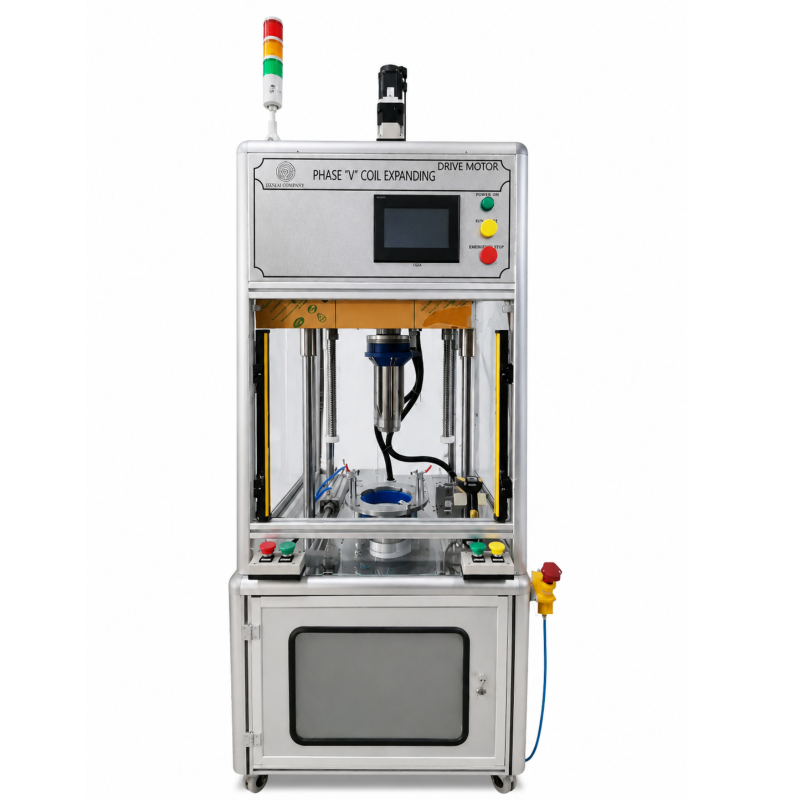
This stator coil expanding machine is designed for pre-forming and expanding both sides of a coil after stator winding insertion. It provides a defined station for the slot-expansion stage between winding work and later stator operations. The machine uses PLC program control with a touchscreen display, so the operating sequence can be managed from one control panel. Once the workpiece is loaded, the machine moves downward and performs expansion when it reaches the designated position.
For a production team, the value of this equipment lies in making this individual forming operation clear and repeatable within the process route. It is motor manufacturing equipment intended for a specific coil-handling task, rather than a replacement for the complete stator production line. Its stated application begins after winding insertion, which helps define where it belongs in the work flow. The equipment can be considered for automotive, new energy vehicle, industrial, elevator, home-appliance, pump, and fan motor applications listed for this machine.
The PLC-controlled coil expander uses two servo motors for separate motion functions. One servo controls expansion-mold position, while the other controls expansion size. This division lets operators address the mold location and the expansion adjustment as separate process settings. Put simply, mold position relates to where the expansion tool works, while expansion size relates to the adjustment made during the operation. The appropriate settings still depend on the actual stator and production process, so workpiece details should be shared when discussing a configuration.
The PLC-controlled coil expander combines program control with a touchscreen display. This control arrangement supports the stated automatic sequence: load the workpiece, allow the machine to move downward, and perform slot expansion at the designated position. For motor manufacturing equipment used in a defined process step, a clear control arrangement can help operators follow the intended sequence without presenting the machine as a claim about whole-line output.
The dual-servo arrangement is a central feature of this machine. The mold-position servo and the expansion-size servo are assigned different functions, allowing the machine to control those two elements independently. That is relevant where the coil-expansion operation needs defined adjustment rather than a single fixed movement. The equipment should be reviewed together with the stator geometry and the intended process route before final settings are selected.
The machine is equipped with an automatic limit function, dual-button start, and a photoelectric safety protection switch. These features are part of the supplied equipment description and support its stated operation. The safety devices should be used according to the applicable operating procedures at the installation site. The machine is therefore described with the safeguards supplied for its working station, while site-level guarding and line responsibility remain separate matters.
The stated limits give visitors a practical starting point for assessing machine fit. For this type of equipment, dimensions and utilities establish the working envelope before tooling or production details are discussed. A compact set of confirmed data is more useful than unsupported performance figures, particularly when considering how the machine may fit an existing stator operation.
| Item | Specified value |
|---|---|
| Stator outside diameter | ≤ Ø120 mm |
| Stator inside diameter | ≥ Ø40 mm |
| Stator core length | 20–150 mm |
| Air pressure | 0.5–0.7 MPa |
| Power supply | 220 V / 50 Hz, 1.5 kW |
| Machine weight | Approximately 500 kg |
| Dimensions | 1000 × 900 × 2110 mm |
These specifications define the supplied equipment in relation to actual stator dimensions, coil condition, tooling requirements, air supply, electrical supply, and available floor space. The supplied 20–150 mm core-length range, together with the stated outside- and inside-diameter limits, provides the starting dimensional context for an application discussion. For ISO 9001 industrial machinery projects, the listed dimensions, utilities, and control features provide product data for configuration discussions. ISO 9001 industrial machinery projects may also define documentation requirements within their own operating practices.
Where a motor process includes coil expansion after winding insertion, this machine can serve as the dedicated station for that operation. It is relevant to the listed automotive and new energy vehicle sectors because the machine is designed to pre-form and expand both sides of the coil. In an EV stator automation project, the machine’s role should be defined alongside the actual infeed, outfeed, workholding, and upstream winding conditions. EV stator automation is not a claim that every line connection is included; it identifies an application context that requires confirmation.
The listed industrial, pump, and fan applications reflect common stator-related uses for this type of motor manufacturing equipment. A PLC-controlled coil expander may be a suitable process station when the stator falls within the stated dimensional range and the required coil-forming step follows winding insertion. For applications involving different motor variants, it is useful to clarify the workpiece dimensions and process sequence first, then review whether the supplied machine limits and expansion arrangement match the intended task.
Elevator and home-appliance motor production are also listed applications. In these settings, the equipment provides a focused solution for the described expansion step rather than a broad claim about finished motor performance. The same principle applies to EV stator automation and conventional motor work: the equipment capability should be considered together with the specific stator, the coil condition after insertion, and the required downstream process.
Many line decisions become clearer when the operation is separated into its actual stages. This equipment is specified for the stage after stator winding insertion, when both sides of the coil require pre-forming and expansion. The PLC-controlled coil expander then performs the downward movement and slot-expansion operation described for the machine. It does not establish requirements for winding, insulation insertion, lacing, testing, or material handling beyond its own station.
A useful next step is to provide the stator outside diameter, inside diameter, core length, coil condition after insertion, and the required operating sequence. With those inputs, the role of the equipment can be discussed in relation to the actual workpiece. The listed working range provides the starting point for considering this dedicated expansion station within the stated operation.
Contact us to discuss this machine for your coil pre-forming and slot-expansion process. Please include the stator dimensions, core length, application sector, available air and electrical supply, and any tooling or integration requirements. This information helps determine whether the stated range of the PLC-controlled coil expander matches the intended operation and whether further configuration discussion is needed.

 EN
