
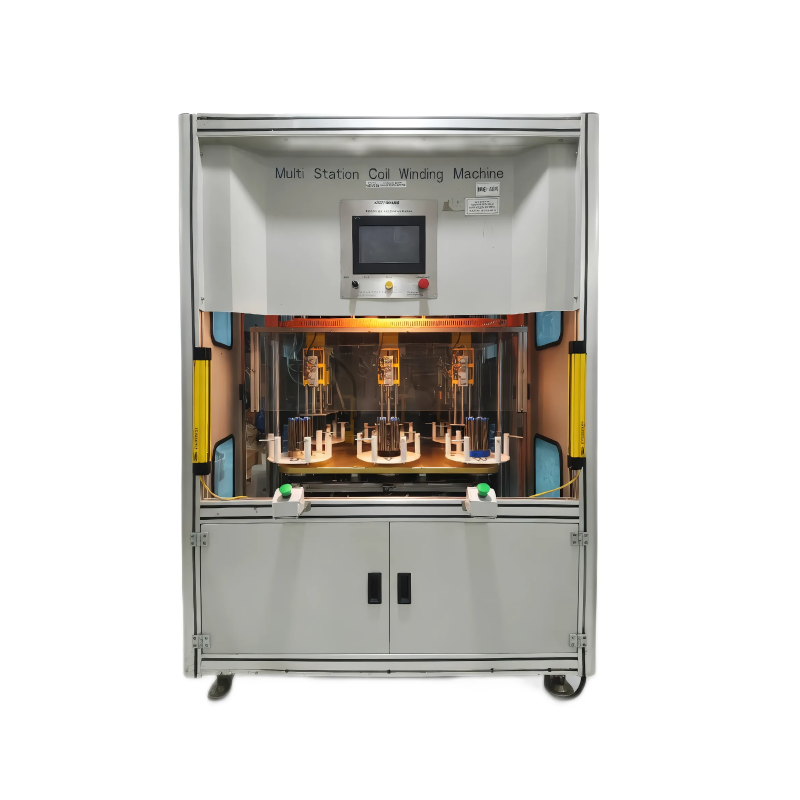
This triple-head six-station vertical winder is designed for stator coil winding where several winding operations need to run within one machine arrangement. Its single-side three-station rotary table structure is described as enabling simultaneous winding of three phases. Three winding heads work with the machine’s winding cups to arrange coils during the stated winding process. For a vertical winder comparison, this configuration gives a clear starting point: review the required stator size, wire range, pole count, and production sequence against the published machine limits.
The machine is intended for motor-coil work rather than a general-purpose winding task. It can automatically complete wire skipping, wire cutting, and indexing in one continuous process. The HMI provides settings for turns, winding speed, mold insertion height, mold insertion speed, and winding direction. Adjustable winding tension, continuous winding, and discontinuous winding functions provide process controls that can be matched to the coil route. In a vertical winder comparison, the relevant equipment features should be considered together with the tooling and stator process used on site.
The three winding heads are paired with six stations and a rotary-table layout. This arrangement is presented for stator winding production where the coil needs to be placed into winding cups. The automatic sequence combines wire skipping, cutting, and indexing instead of leaving those named functions as separate manual actions. A high-efficiency winding machine is useful when its stated wire, stator, and process limits correspond to the product being wound; the surrounding material handling and downstream work remain separate parts of a production line.
For motor coil automation integration, the machine functions should be reviewed against the way coils enter and leave the process. The equipment can carry out the listed winding actions, while feeders, safety arrangements, inspection equipment, and other connected stations require their own application planning. This scope distinction helps keep motor coil automation integration focused on the confirmed machine interfaces rather than on unlisted line capabilities.
The following values come from the existing product material. They define the documented working envelope for this vertical winder and should be used as the reference for application discussion.
| Item | Published specification |
|---|---|
| Wire size limit | Ø0.19–Ø1.2 mm |
| Flyer diameter | Ø220 mm |
| Winding heads | 3 |
| Maximum stator core length | 120 mm |
| Maximum stator outside diameter | Ø150 mm |
| Maximum winding speed | 2200 rpm |
| Air pressure | ≥0.5 MPa |
| Power supply | 380 V, 50/60 Hz, 15 kW |
| Approximate machine weight | 3500 kg |
| Dimensions | 2300 × 1550 × 2250 mm |
A vertical winder comparison is more useful when these limits are read as a set rather than as isolated figures. Wire diameter, flyer size, stator core length, stator outside diameter, and winding speed relate to the particular coil and stator design. The machine is stated to meet winding requirements for 2-pole, 4-pole, 6-pole, 8-pole, and 12-pole motor coils. If an application falls outside these published limits, discuss the process route and technical requirements before selecting a configuration.
The source material lists fuel automotive, new energy vehicle, industrial, elevator, home appliance, pump, and fan applications. These are application areas for motor coils and stators; they do not replace confirmation of the actual motor design. For motor coil automation integration, begin with the coil form, pole arrangement, wire size, stator dimensions, and required winding sequence. Those inputs clarify whether the listed machine functions align with the intended process.
The HMI enables operators to enter process settings instead of treating every winding arrangement as fixed. Number of turns and winding direction describe the coil pattern, while winding speed and mold insertion settings relate to the machine operation. Adjustable tension adds another process setting that should be established for the wire and coil requirements in use. This makes the high-efficiency winding machine description meaningful only in the context of a compatible stator application and an appropriately configured process.
For an industrial winder supplier inquiry, provide the intended wire diameter, stator core length, stator outside diameter, pole count, and electrical supply information. Also describe the required coil route and any connected equipment. An industrial winder supplier can then discuss the published machine range with the details that define the application instead of relying on a generic motor category alone.
Stator winding ROI is not a fixed machine specification. It is a process consideration that depends on the application conditions, including product mix, cycle planning, tooling, labor arrangement, material handling, and maintenance practices. The published configuration supports a conversation about how three winding heads, six stations, and automatic wire actions may fit a given winding route. It does not establish a savings figure or an output result for every installation.
A practical vertical winder comparison can focus on the available functions and the limits that govern fit. Consider whether the Ø0.19–Ø1.2 mm wire range covers the required wire, whether the 120 mm maximum core length and Ø150 mm maximum outside diameter suit the stator, and whether the stated 2200 rpm maximum is appropriate for the planned winding operation. These questions translate technical values into the information needed to discuss equipment use without assuming an unverified outcome.
Stator winding ROI can also be considered alongside the intended workflow. Where the machine’s continuous process includes wire skipping, cutting, and indexing, the effect on a specific operation will depend on the coil design and line arrangement. The machine scope is the listed winding function; full-line performance depends on the wider installation. This distinction is useful for motor coil automation integration because it keeps the equipment description tied to what the product material confirms.
This triple-head vertical winder offers a documented configuration for stator coil production with three winding heads, a six-station layout, adjustable process settings, and stated compatibility for 2-pole through 12-pole motor coils. The high-efficiency winding machine concept should be applied to the published features and to the conditions of the actual motor program. A high-efficiency winding machine is not defined by speed alone; wire, stator dimensions, tooling, and the selected winding sequence all matter.
When contacting an industrial winder supplier, share the target motor application and the specifications that are important for the coil. Stator winding ROI can be discussed after the winding route, production conditions, and integration requirements are understood. For motor coil automation integration, include the upstream and downstream equipment information so the interfaces can be considered separately from the vertical winder itself.
Use this vertical winder comparison as an introduction to the Triple-Head Six-Station Vertical Winder’s documented operating range. An industrial winder supplier discussion can then focus on matching the machine’s wire, stator, pole-count, electrical, and installation requirements to the intended use. This approach also keeps high-efficiency winding machine expectations aligned with the confirmed product configuration and the specific coil process.

 EN
