
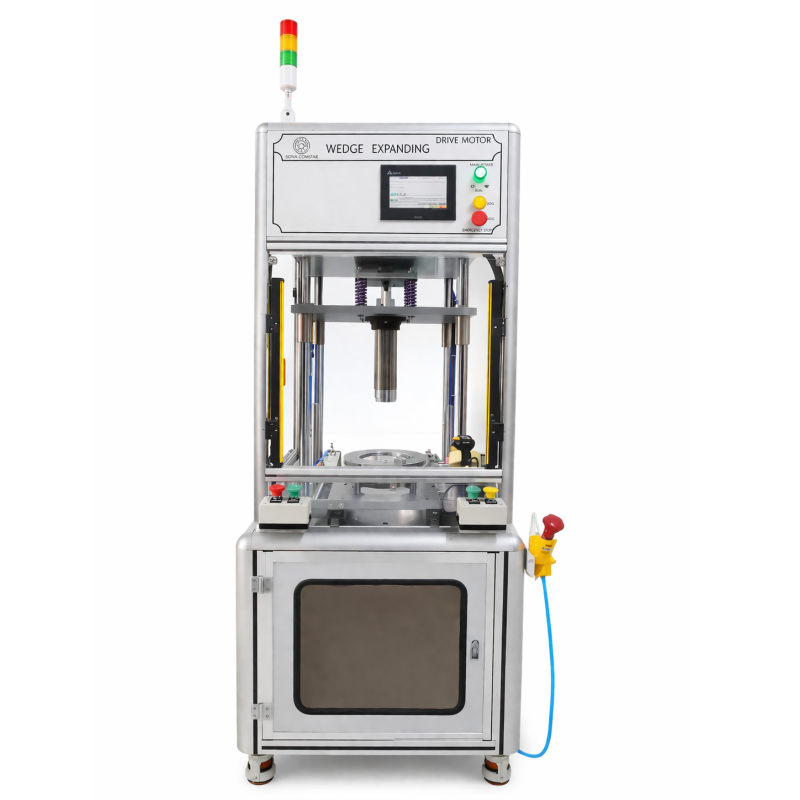
This stator wedge expanding machine is designed for the operation that follows final motor forming: pushing slot wedge paper firmly toward the bottom of the stator slot. It gives a defined mechanical step to an operation that can otherwise depend heavily on manual handling. The workpiece is loaded, the machine moves downward automatically, and expansion takes place when the designated position is reached. A pneumatic cylinder supplies the main driving force for the wedge-expansion action.
As motor stator assembly equipment, this unit is intended for production teams that need a clear, repeatable step for slot wedge expansion. The machine itself addresses the wedge-expansion operation; upstream forming, material preparation, and downstream assembly remain separate process considerations. This scope distinction helps users focus the inquiry on the stator dimensions, wedge material, fixture needs, and production route that affect machine fit.
The supplied configuration uses PLC-controlled industrial automation with a touchscreen display. That combination supports direct operator interaction with the programmed operation while retaining an automatic downward movement after loading. For a stator wedge expanding machine, a programmed sequence is most relevant when the workpiece and operating route have been defined beforehand. The stated mechanical limit function, dual-button start, and photoelectric safety protection switch add practical safeguards around the working cycle.
These features describe the supplied operating concept rather than a complete motor-production line. When reviewing motor stator assembly equipment, the practical question is not only whether a function is present, but whether the supported stator range and operating conditions match the current workpiece. In that context, PLC-controlled industrial automation provides a structured control method for the stated operation, while the pneumatic and safety arrangements support the machine’s defined working cycle.
| Item | Specified Value |
|---|---|
| Stator outside diameter limit | ≤ Ø120 mm |
| Stator inside diameter limit | ≥ Ø40 mm |
| Stator core length limit | 20–150 mm |
| Air pressure | 0.5–0.7 MPa |
| Power supply | 220 V / 50 Hz, 0.5 kW |
| Machine weight | Approximately 500 kg |
| Overall dimensions | 1000 × 900 × 2110 mm |
The dimensional limits are central to machine matching. A stator wedge expanding machine is suited to workpieces within the listed outside-diameter, inside-diameter, and core-length ranges. Air supply, electrical supply, floor space, and handling arrangements should be considered with these stated values. PLC-controlled industrial automation describes the control arrangement; it does not replace confirmation of the surrounding utilities or the workpiece-specific setup.
The listed applications include fuel automotive, new energy vehicle, industrial, elevator, home appliance, pump, and fan motor production. Across these applications, the common requirement is a stator process that calls for wedge paper to be expanded into the bottom of the slot after final forming. A stator wedge expanding machine can provide a dedicated station for that operation when the workpiece falls within the stated limits.
For automotive and new energy vehicle programs, motor stator assembly equipment can be considered where the final-forming sequence includes a defined wedge-expansion step. For pump, fan, elevator, home-appliance, and general industrial motors, the same consideration applies: the stator dimensions, paper type, slot arrangement, and required handling sequence determine whether the supplied configuration is appropriate. This is a product page for the machine’s documented operating role, not a claim that one setup fits every motor design.
For CE-certified motor manufacturing projects, installation and guarding requirements should be considered for the intended site. A slot wedge insertion ROI discussion can be based on the current operating method, staffing, output targets, and proposed configuration, keeping the discussion connected to the actual production process.
PLC-controlled industrial automation is useful when a clearly defined sequence is needed, but machine fit begins with the stator and the wedge paper. Before selecting a stator wedge expanding machine, prepare the stator outside diameter, inside diameter, core length, slot and wedge-paper details, available air pressure, electrical supply, and required process position. These details make it easier to confirm whether the stated range and operating sequence are suitable.
Motor stator assembly equipment is often evaluated alongside adjacent operations, yet each station has its own responsibility. The supplied stator wedge expanding machine focuses on pushing the slot wedge piece into position. Tooling, material handling, upstream forming conditions, and integration with other stations should be discussed separately. More functions do not automatically make a current stator process more suitable; a configuration that matches the actual stator dimensions and work sequence is the more useful starting point.
CE-certified motor manufacturing projects may have site-specific installation and guarding considerations. If your team is assessing slot wedge insertion ROI, share the current operating method, staffing, output targets, and required process position so the discussion can focus on the stated machine function and application.
For an application discussion, provide the stator OD, stator ID, core length, wedge-paper information, air supply, power conditions, and the position of wedge expansion in your process. This information supports a focused conversation about the stator wedge expanding machine and its stated operating range. It also helps distinguish the supplied machine scope from any separate tooling or line-integration requirements.
The machine combines the documented PLC touchscreen control, pneumatic expansion drive, stated dimensional limits, and listed safety functions in one dedicated wedge-expansion station. Contact Ningbo Rimy Electrical to discuss your application and confirm the configuration details relevant to your motor stator assembly equipment project.

 EN
